Master’s thesis · Spring 2026 · MSc HCI, Kristiania
Missing universal design culture ripples into work methods
Accessibility and universal design are well addressed in customer-facing products, because the law requires them. But what about the tools people need to do their jobs? That gap is where Mia Akre and I spent the spring of 2026, writing our master’s thesis with Telenor Norway as our case.
Together we interviewed 28 people working as designers, developers and managers at Telenor, across 49 interviews. In the analysis, Mia looked for the factors that promote universal design, and I for the ones that obstruct it.
The result was systemic insights into how Telenor could increase the degree of universal design in their internal systems.
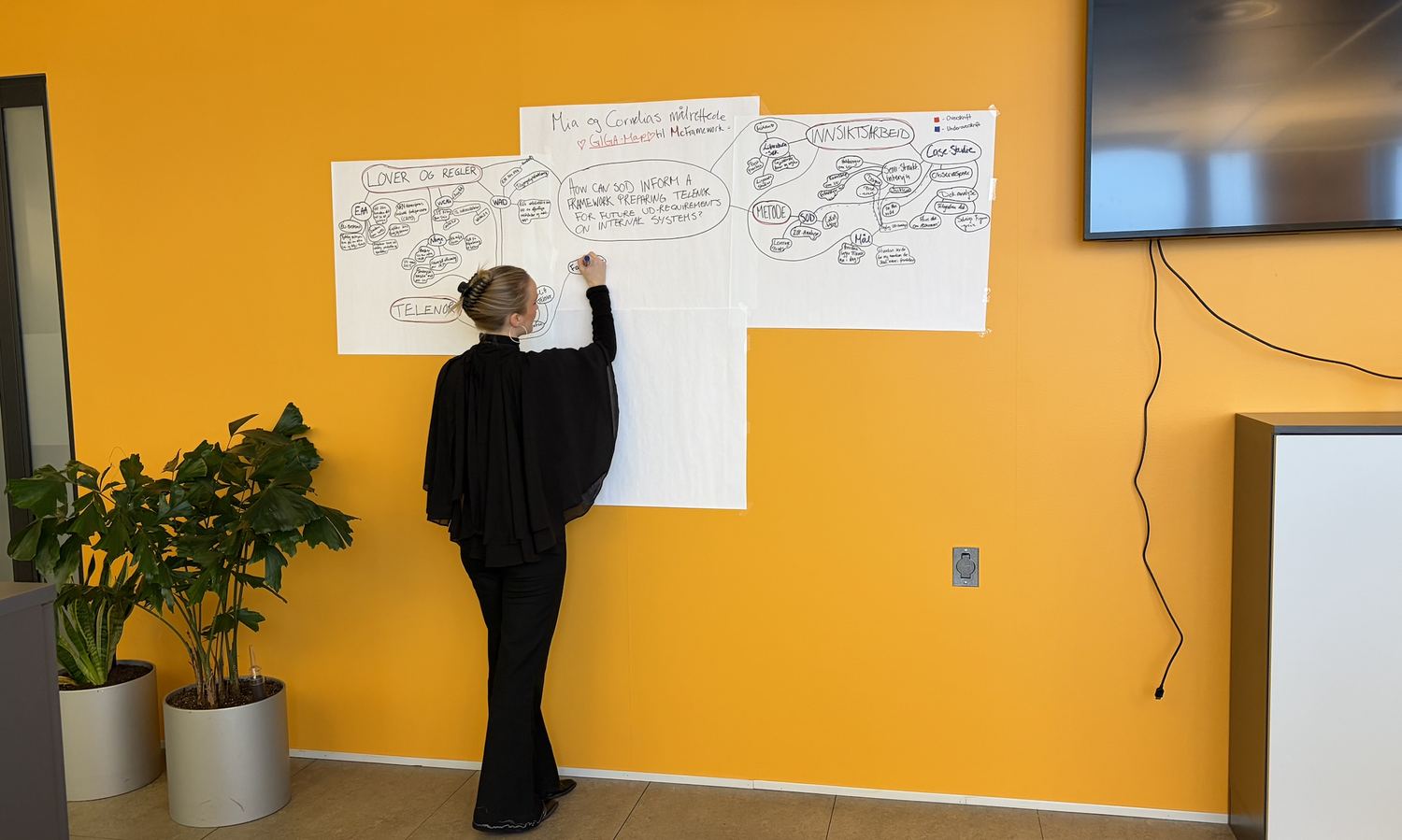
One company, two cases
The thesis is based on two cases within Telenor: Case 1, working on internal systems development, and Case 2, working on customer-facing solutions. This was done because the problem we wanted to work on — the absence of universal design — was present in Case 1, while in Case 2 universal design was being practiced.
In both cases, we spoke with the roles relevant to product development: managers, developers and designers. The interview phase was stopped when we reached the saturation point, where each role had stopped giving us new information. This led to 49 interviews being held with 28 individual participants.
What stops universal design
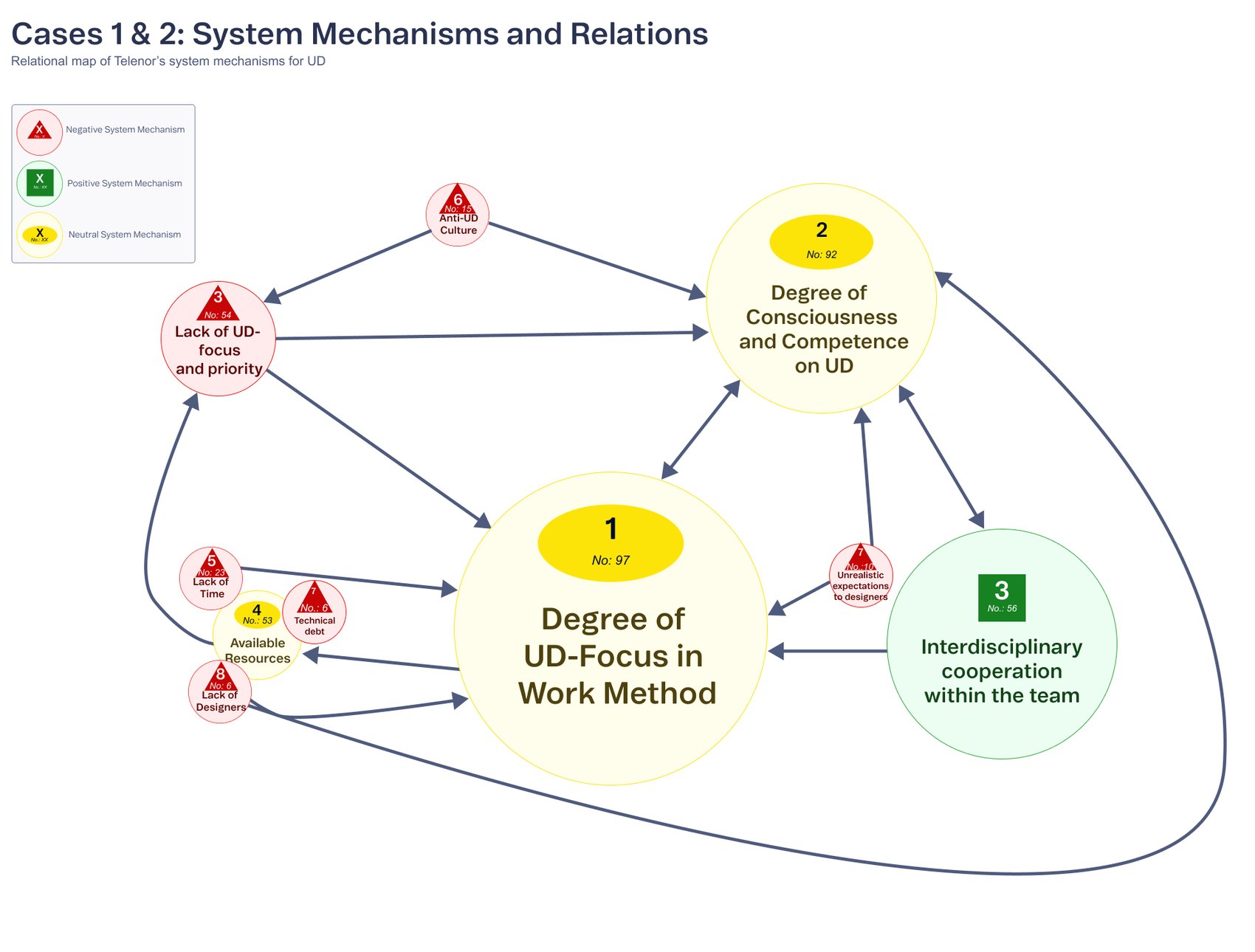
When analyzing what factors were present at Telenor, Mia and I coded independently. She looked for promoting factors, while I identified obstructing ones. The obstacles turned out to be quite similar across the two cases, though varying in size. In Case 1, we identified 177 obstructing and 105 promoting codes; in Case 2, 64 obstructing and 89 promoting.
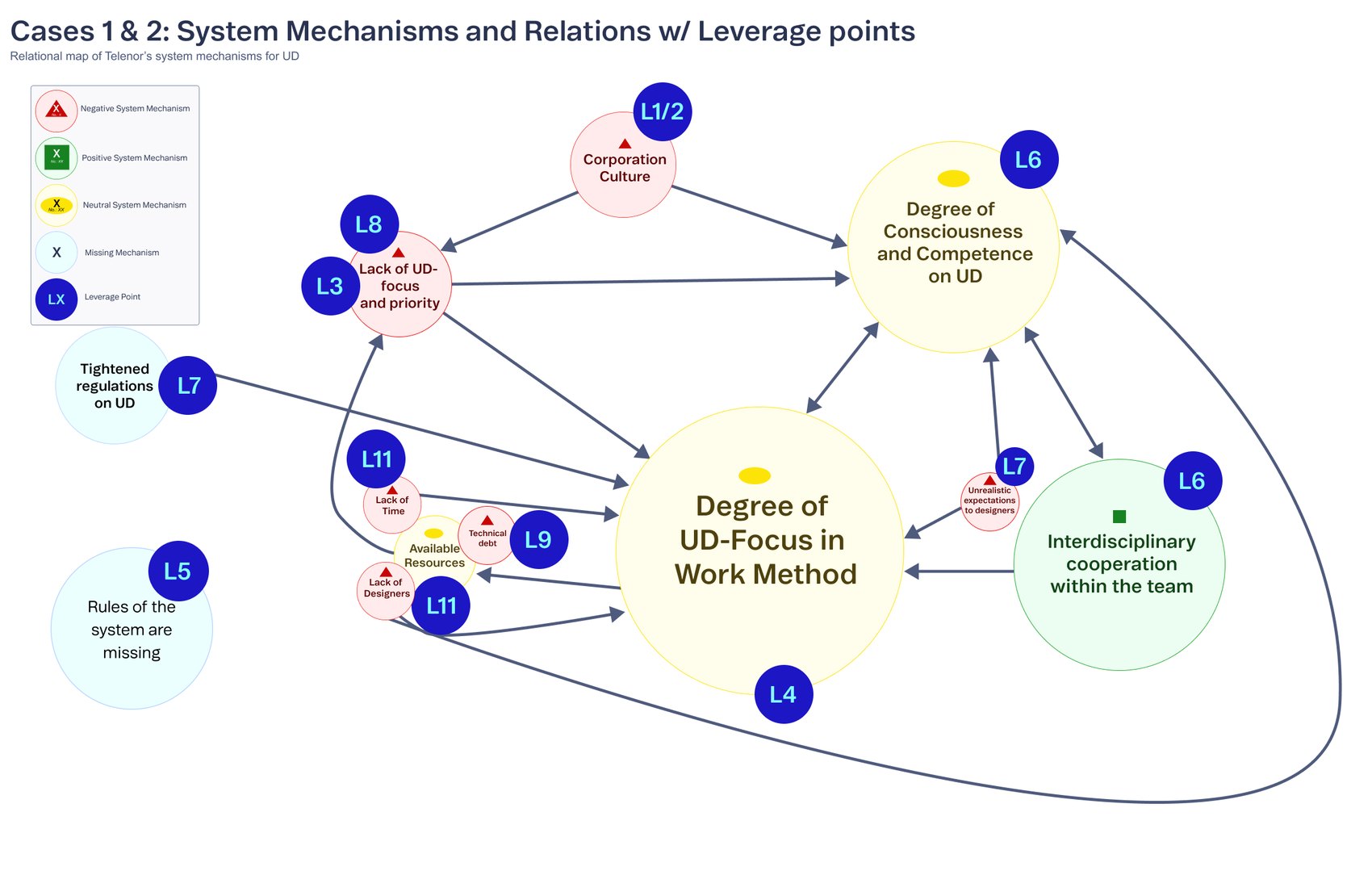
The most influential obstructing factor, lack of UD culture, is not the most mentioned one. According to Meadows’ leverage points, corporation culture is the most impactful place to intervene in a system.
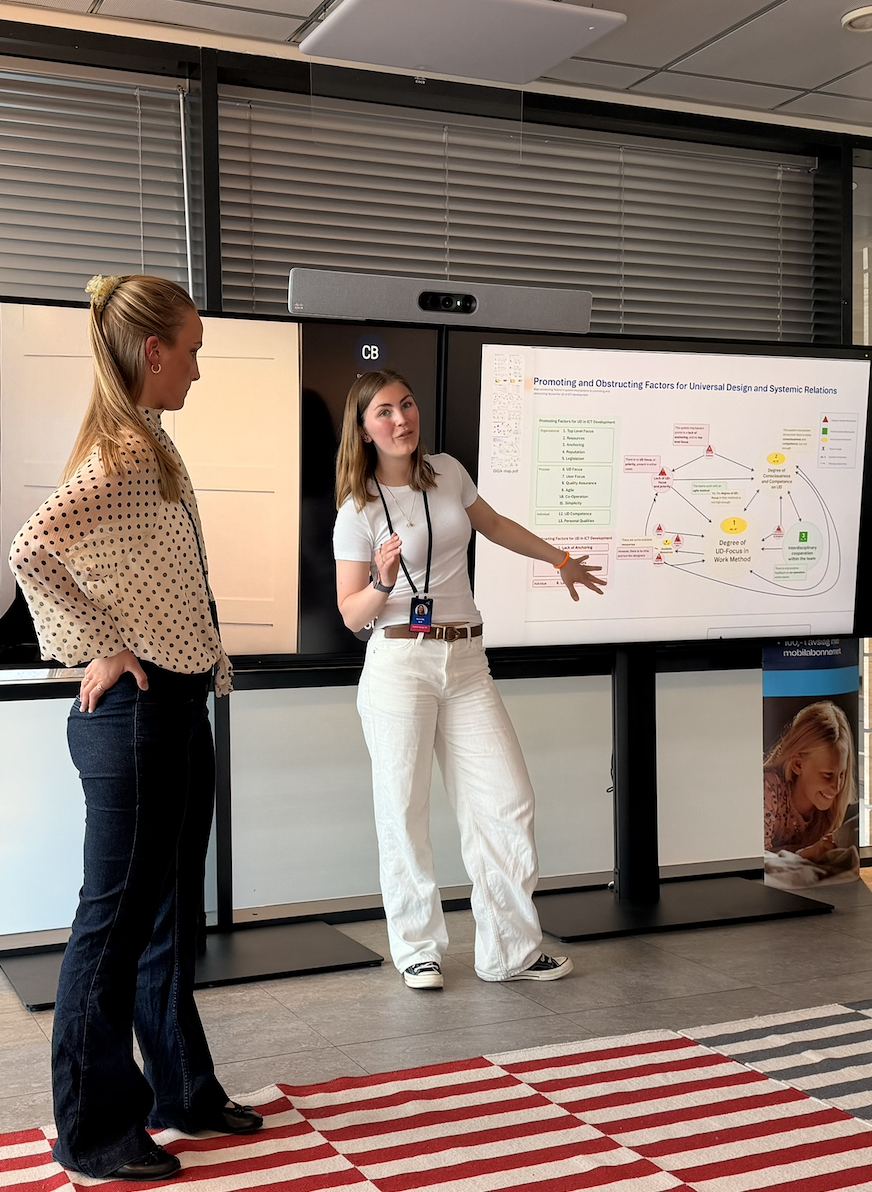
The lack of UD culture causes a ripple effect through the company. Without the culture, there appears to be no prioritization of UD from the leadership. Without prioritization, consciousness and competence do not grow. These factors in turn lead to UD not being implemented in their work processes.
Furthermore, expectations towards the designer’s role become unrealistic. We found that both leaders and developers expect their designers to work with UD, even though these expectations are never addressed inside the teams. Additionally, many designers say there is not enough time for UD, and some teams have no designer at all.
Lastly, our analysis found a system mechanism that was missing: the rules of the system. Rules can only be introduced once prioritization, competence and consciousness are in place — which is why this is the last intervention we recommend.
What we recommended
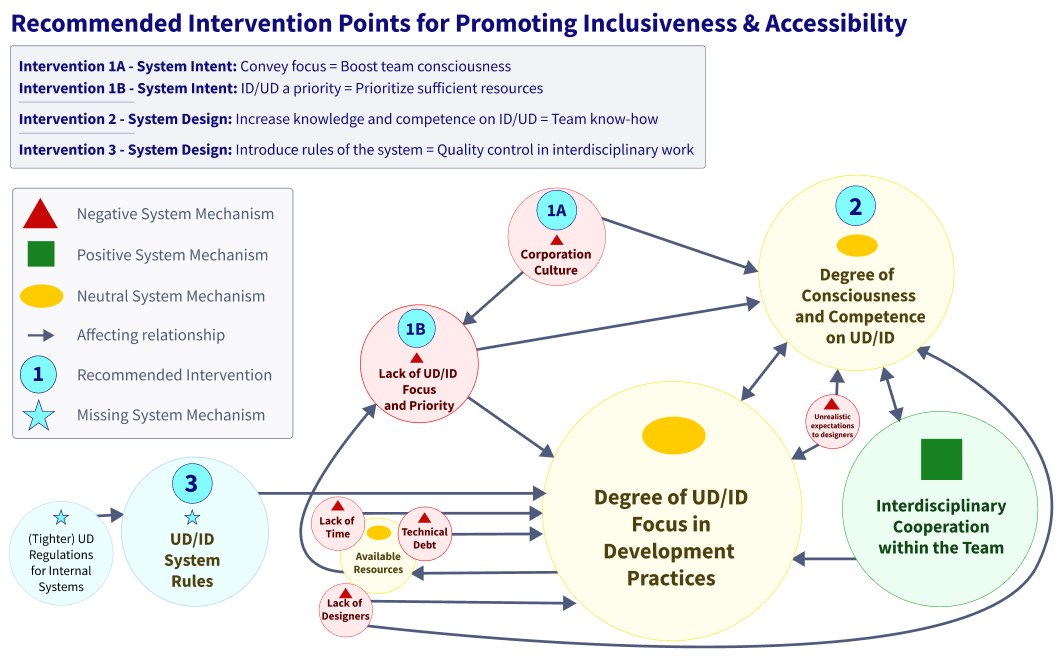
As a result of our analyses, Mia and I recommended three concrete interventions to Telenor.
Intervention 1 consists of increasing focus and priority towards UD, and is tied to leverage points 1, 2, 3 and 8. Here, we hypothesize that a stronger managerial focus can lead to increased awareness across the organization. Adding prioritization to the increased focus should lead to more resources allocated, attention on the issue, and introduction of ways of working for promoting UD.
Once intervention 1 is in place, intervention 2 should naturally follow: increasing knowledge and competence — leverage point 6. By increasing these two points across the workforce, UD-appropriate work methods should be implemented, interdisciplinary co-operation improved, and unrealistic expectations addressed.
The last intervention, which should come into play once the two others are implemented, is the introduction of rules and requirements. This leverage point, number 5, was missing entirely in the system we investigated. We recommend an organization-wide standard for UD in products and services, including quality testing and compliance requirements.
The interventions were handed over to Telenor through a presentation in May, with an audience from multiple parts of the organization.
What it changed about how I work
Working with accessibility and UD in an organization for a semester opened my eyes both to its importance and to why it is often forgotten. Making sure to talk about UD with my team, and keeping it a natural part of how we work, has become a habit. Additionally, user testing with a larger and more varied group of subjects matters more to me now than it did before. As one says, UD is necessary for some, beneficial for all.
This case study is a summary of the full thesis, Towards an Inclusive Workplace: Using Systems-Oriented Design to Develop Recommendations for Universal Design of Internal Systems. The thesis will be made available by Kristiania, and I can be contacted for the full text in the meantime.